Friday, April 25, 2014

NY Times Article - Map of Baseball Allegiance

Up Close on Baseball's Borders

By TOM GIRATIKANON, JOSH KATZ, DAVID LEONHARDT and KEVIN QUEALYAPRIL 24, 2014

Steve Rushin of Sports Illustrated has called the line running through Connecticut that separates Yankee fans and Red Sox fans the Munson-Nixon line. Mr. Rushin came up with the name — in honor of the late Yankee catcher Thurman Munson and the retired Red Sox right fielder Trot Nixon — in 2003, and he had to guess where the line ran: "north of New Haven but south of Hartford, running the breadth of central Connecticut."

We don't have to guess anymore.

Fans may not list which team they favor on the census, but millions of them do make their preferences public on Facebook. Using aggregated data provided by the company, we were able to create an unprecedented look at the geography of baseball fandom, going down not only to the county level, as Facebook did in a nationwide map it released a few weeks ago, but also to ZIP codes. We can now clearly see that both Hartford and New Haven are in fact Yankee outposts. We can also determine the precise Chicago neighborhoods where White Sox jerseys stop being welcome and the central California town where the Dodgers cede fan favorite status to the Giants.

We've created two features to help readers explore the data. First is an interactive map of the United States that allows you to explore not just the most popular team in your neighborhood but also a table of the top teams for any ZIP code in the country.

Second, in the spirit of Mr. Rushin's Munson-Nixon line, we've generated 14 maps detailing baseball's biggest rivalries, highlighting the borders and offering suggested names for those lines.

The maps were created using estimates of team support based on how many Facebook users "liked" each team in a ZIP code. We applied an algorithm to smooth the data and fill in gaps where data was missing.

If you have alternate suggestions for border names, or have an idea or suggestion for a map not shown here, leave us a message in the comments or on Twitter or our Facebook page. We'll be updating this list regularly. Hopefully, this is just the start.

New York Yankees vs. Boston Red Sox
Munson-Nixon Redux

We begin with a new take on the Munson-Nixon line, which differs from some previous interpretations in that it shows that Hartford has declared for the Yankees. It's still a border town, but it's a border town the way El Paso is — clearly on the Yankee side. One tidbit: Red Sox Nation seems to have conquered some new territory since 2012, when Ben Blatt tried to draw such a line. (Winning a World Series will do that.) We also encourage you to read our colleague John Branch's attempt at drawing the line in 2006, which is quite impressive and accurate given his shoe-leather means.

New York Mets vs. New York Yankees
The We'd-Draw-a-Line-If-We-Could Line

There's no other way to put it: The Yankees are the preferred team everywhere in New York City, and nearly everywhere in the U.S. over the Mets (in more than 98 percent of ZIP codes nationwide). One small Mets bright spot, if you want to call it that, is that in the area in Queens surrounding Citi Field, where the Mets play, Facebook users had the courtesy to prefer what some call the Evil Empire at a slightly reduced rate relative to its advantage elsewhere in New York.

Minnesota Twins vs. Milwaukee Brewers
The Molitor Line

Minnesotans and Wisconsinites don't admit to having much in common, but in sports they have sometimes been forced to share. The most notable example is probably Paul Molitor, for whom our border is named. Molitor, a Hall of Famer from St. Paul whose name sounds conveniently similar to Maginot, played most of his career with the Brewers but finished it with the Twins. The teams' fans display a certain Midwestern stubbornness in keeping their allegiances roughly to state lines, with the exception of those WINOs (Wisconsinites in name only) who live just over the river from the Twin Cities. There's no real animosity between these two teams, given that they rarely play each other now. Still, don't put the peace at risk by bringing up Brett Favre.

Chicago Cubs vs. Chicago White Sox
The Red Line Red Line

Helped by the charm of their field and by WGN's national broadcast reach, the Cubs have always been the better-loved of Chicago's two teams. But the White Sox — unlike the Mets or the A's — do have a patch of their own territory, on the city's South Side and into the southern suburbs. Interstate 290 (the Dwight D. Eisenhower Expressway) is a rough guide to the border: Know whether you're north or south of it before you put on your hat.

Los Angeles Dodgers vs. Los Angeles Angels
The Reagan-Nixon Line

Among all the second-favorite teams — including the Mets, the A's and the White Sox — the Angels have done perhaps the best job of carving out a niche of fans. But despite the inroads made by the Angels, the Dodgers are still the clear favorite in Southern California. Their territory extends east to Big Bear Lake and west to Seal Beach. Also perhaps in the Dodgers' favor: The Ronald Reagan Library is in their territory, while the Angels have the Richard Nixon Library.

San Francisco Giants vs. Oakland Athletics
Giant Country

Like the Mets, the Athletics are the less popular team in a two-team region — less popular everywhere in that region, based on the data from Facebook. Again, winning the World Series matters. The Giants have won two of the last four. The A's have won none of the last 24.
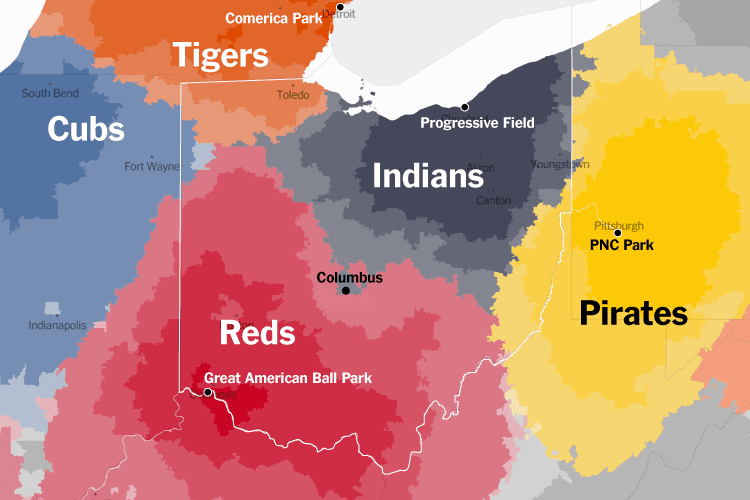
Oh, Ohio
On to Columbus

Few states give their fans as many options as Ohio does. A fair-weather fan in the central part of the state could claim allegiance to several teams within a day's drive: not just the Reds and the Indians but the Cubs, the White Sox, the Pirates, the Tigers or even the Cardinals. But most Ohioans stay loyal to the home-state teams, and the border is right where you'd guess. It runs straight though Columbus, Ohio's capital and largest city, in the middle of the state. One small exception to the Reds' and Indians' dominance: The longtime presence of the Tigers' top minor league team in Toledo — the Mud Hens, the favorite team of Corporal Klinger from the television show "M*A*S*H" — has helped the Tigers claim some territory in northern Ohio.

St. Louis Cardinals vs. Kansas City Royals
The Denkinger Line

The Show Me State has mostly thrown in with the Cardinals, who have been as good for the last two decades as the Royals have been bad. The line is well west of the halfway point between the two cities — Columbia, Mo. — and instead runs through Sedalia and Pittsburg. We can only guess what this map would have looked like in 1985, when a missed call by Umpire Don Denkinger helped the Royals win their last World Series, over the Cardinals. Unfortunately, there's no Facebook map for that: Mark Zuckerberg was not yet 2 years old.

New York Mets vs. Philadelphia Phillies
The Sub-Hoagie Line

A common mistake in data analysis is to confuse correlation with causation; just because things are related doesn't mean one caused the other. At the same time, last year's New York Times analysis of American dialects allows us to notice a striking pattern: Which N.L. East team you root for may be revealed by whether you call long sandwiches subs or hoagies. We don't know which causes which, but we do know they go together – except, possibly, in Trenton.*

Houston Astros vs. Texas Rangers
The Nolan Ryan Line

The state of Texas belongs to the Rangers, and why not? The team claims to represent the whole state, whereas the Astros belong merely to Houston, at least going by their name. It doesn't hurt that the Rangers have made the postseason three times in four years, while the Astros, who have been dreadful for several years, can't decide on a logo or even seemingly what league they're in. Many Houstonians also take pride in being a bit different from other Texans. Those other Texans apparently agree.

Washington Nationals vs. Baltimore Orioles
The Line of Potomac Aggression

After the departure of the Senators in 1971, Washingtonians spent decades alternately lamenting their plight and treating the Orioles as their home team. That era is over. While the Orioles have held onto many Maryland suburbs, the Nats now dominate Washington and much of the Virginia suburbs. In parts of the Washington region, the Orioles aren't even the second-favorite team; the Yankees or the Red Sox are.

Chicago Cubs vs. St. Louis Cardinals
The Downstate Line

Most states with a team have few areas that side with an out-of-state rival. Not so in Illinois, where half the state stands in open revolt. Bloomington, Champaign and Peoria appear to belong to the Cubs, but south of those cities, expect to see a lot of Cardinal red. If you're a longtime resident of this area, you may want to look up whether your ancestors voted for or against Abraham Lincoln in 1860.

Baltimore Orioles vs. Philadelphia Phillies
The Morgan-Ripken Line

The South may have lost the Civil War, but the Orioles have done a better job of pushing north above the Mason-Dixon line than the Phillies have done expanding beyond their home state. Notably, the Orioles have won over Gettysburg, Pa. We've named the Orioles-Phillies border for two of the protagonists in the 1983 World Series, which the Orioles won in five games.

Southern California
Highway 1 Passport

Southern California is a group of small nation-states. San Luis Obispo, often considered a halfway point between the Giants and the Dodgers, is squarely Dodgers territory, according to Facebook users. Further south, the Padres have problems. The baseball writer Joe Sheehan has noted their major challenges in raising revenue, given that they are hemmed in by the Pacific Ocean, the Mexican border, a desert and the Dodgers and the Angels. No one symbolizes the plight of the Padres, who have never won a World Series, quite as well as Adrian Gonzalez. Born in San Diego, he spent five years as a Padres slugger. But they couldn't afford him, and he now leads the Dodgers in home runs.

*Note: The New York Yankees were removed to make this map possible.

http://www.nytimes.com/interactive/2014/04/23/upshot/24-upshot-baseball.html?hp&_r=0
http://www.nytimes.com/interactive/2014/04/24/upshot/facebook-baseball-map.html#3,45.260,-122.142

Thursday, April 3, 2014

NY Times Article

http://www.nytimes.com/2014/04/03/fashion/normcore-fashion-movement-or-massive-in-joke.html?src=dayp&_r=0

The New Normal

Normcore: Fashion Movement or Massive In-Joke?

By ALEX WILLIAMSAPRIL 2, 2014

Inside
Photo

Calling these clothing items part of a trend or an inside joke misses the point.

Normcore (noun) 1. A fashion movement, c. 2014, in which scruffy young urbanites swear off the tired street-style clichés of the last decade — skinny jeans, wallet chains, flannel shirts — in favor of a less-ironic (but still pretty ironic) embrace of bland, suburban anti-fashion attire. (See Jeans, mom. Sneakers, white.)

2. A sociocultural concept, c. 2013, having nothing to do with fashion, that concerns hipster types learning to get over themselves, sometimes even enough to enjoy mainstream pleasures like football along with the rest of the crowd.

3. An Internet meme that turned into a massive in-joke that the news media keeps falling for. (See below).

A little more than a month ago, the word "normcore" spread like a brush fire across the fashionable corners of the Internet, giving name to a supposed style trend where dressing like a tourist — non-ironic sweatshirts, white sneakers and Jerry Seinfeld-like dad jeans — is the ultimate fashion statement.

As widely interpreted, normcore was mall chic for people — mostly the downtown/Brooklyn creative crowd — who would not be caught dead in a shopping mall. Forget Martin Van Buren mutton chops; the way to stand out on the streets of Bushwick in 2014, apparently, is in a pair of Gap cargo shorts, a Coors Light T-shirt and a Nike golf hat.

Normcore vs. Fauxcore

Normcore: New Balance Classics M574, imported. $64.95 on Zappos.

Fauxcore: New Balance 998 for J. Crew, made in Skowhegan, Me. $160 on jcrew.com.

Left to right: Amazon.com; J. Crew

Regardless of how insular the concept may be (Stop the presses! People are dressing in normal clothes!), the idea has spread far beyond the 718 area code. A Google search of normcore now yields about 559,000 results. Fashion publications like Lucky have offered normcore shopping guides brimming with velour pants and Teva sandals. Even the French were quick to give "le normcore" a kiss-kiss on both cheeks, as if it were the Jerry Lewis of American style trends.

A style revolution? A giant in-joke? At this point, it hardly seems to matter. After a month-plus blizzard of commentary, normcore may be a hypothetical movement that turns into a real movement through the power of sheer momentum.

Even so, the fundamental question — is normcore real? — remains a matter of debate, even among the people who foisted the term upon the world.

The catchy neologism was coined by K-Hole, a New York-based group of theoretically minded brand consultants in their 20s, as part of a recent trend-forecasting report, "Youth Mode: A Report on Freedom." Written in the academic language of an art manifesto, the report was conceived in part as a work of conceptual art produced for a London gallery, not a corporate client.

As envisioned by its creators, "normcore" was not a fashion trend, but a broader sociological attitude. The basic idea is that young alternative types had devoted so much energy to trying to define themselves as individuals, through ever-quirkier style flourishes like handlebar mustaches or esoteric pursuits like artisanal pickling, that they had lost the joy of belonging that comes with being part of the group. Normcore was about dropping the pretense and learning to throw themselves into, without detachment, whatever subcultures or activities they stumbled into, even if they were mainstream. "You might not understand the rules of football, but you can still get a thrill from the roar of the crowd at the World Cup," the report read. The term remained little more than a conversation starter for art-world cocktail parties until New York magazine published a splashy trend story on Feb. 24 titled "Normcore: Fashion for Those Who Realize They're One in 7 Billion." The writer, Fiona Duncan, chronicled the emergence of "the kind of dad-brand non-style you might have once associated with Jerry Seinfeld, but transposed on a Cooper Union student with William Gibson glasses." An accompanying fashion spread dug up real-life L-train denizens rocking mall-ready Nike baseball caps and stonewashed boyfriend jeans without apparent shame.

Even so, it was difficult to tell if anyone actually believed the hype. For one thing, the normcore brain trust started to circle the wagons. Christopher Glazek, a journalist and friend of the K-Hole founders took to Facebook to blow holes in the "trend." "It doesn't really make sense to identify normcore as a fashion trend," he wrote. "The point of normcore is that you could dress like a Nascar mascot for a big race and then switch to raver ware for a long druggie night at the club."

Normcore Hall of Fame

James Blake The English crooner dresses like a walking laundry hamper. Suddenly, that seems like a good thing.

Andy Sheppard/Redferns, via Getty Images

Ms. Duncan, too, seemed to chafe under her de facto role as the high priestess of normcore. In a Facebook comment, later removed, she complained that her original take on normcore had been boiled down by her editors from a more sociological foray, à la K-Hole, into a narrow fashion piece. "I considered killing the piece every time it came back w/ more fashion, less reflection," she wrote.

It hardly mattered. Normcore had taken on a life of its own.

Within days of the article, GQ magazine used the term to describe an emergent frump-chic look that was detectable in high fashion: "Men's wear designers like Patrik Ervell and Louis Vuitton's Kim Jones have taken the classic Patagonia Retro-X fleece jacket and made it luxe. Birkenstocks aren't just a fashion statement, they've got designer collaborations."

Online, the normcore-spotting of celebrities — Adam Sandler in Adidas training pants, Jimmy Kimmel in an untucked dress shirt — became sport. It got so out of hand that someone created the Google Chrome extension No More #NORMCORE, which blocks references to the term.

Predictably, a normcore backlash was soon brewing. In an Elle.com post called "Why the 'Normcore' Phenomenon is a Fraud," Lauren Sherman described it as '90s retro dressed up in ideological drag. "Dressing like an uncool dad is in the fiber of hipster culture," she wrote. "It's just that, until now, the '70s and early '80s were the go-to reference point. Now that the '90s are coming into play, adults who were teenagers during that era distinctly recall living among Jerry Seinfelds clad in white sneakers and ill-fitting jeans."

But the backlash only served to reinforce the trend, as normcore continued to metastasize beyond fashion circles.

Credit Lee Oliveira

The website for Dazed and Confused, the British style magazine, attempted to answer the musical question "What does Normcore sound like?" (Think of Devonté Hynes, Sean Nicholas Savage and Fleetwood Mac.) Car and Driver offered "The 5 Most Normcore Automobiles" (they selected five Toyota Camry models).

Like a mass sociological experiment, the question now is whether repetition, at a certain point, makes reality. Even those who coined the phrase concede that normcore has taken on a life of its own. "If you look through #normcore on Twitter or Instagram, people are definitely posting pictures of that look," said Gregory Fong, a K-Hole founder. "Whether they believe it's real or a joke, it's impossible to say, but it's there and it's happening."

It certainly seems to be. Sort of.

Style watchers at some of New York's trendier boutiques are getting glimpses. "There's always a hunger to find the next thing, start a new movement, and you can see a little bit of that in the normcore movement — the light washes and the Jesus sandals coming back," said Matthew Breen, a founder of Carson Street Clothiers in SoHo. "I think it's a complete media creation," he added. "But the second GQ writes about it, then it becomes a trend."

Francesca Grosso, a manager at Opening Ceremony in SoHo, said she had never heard anyone mention normcore on the sales floor, but still, she said she saw influences on the streets. "It's girls wearing Timberlands, wearing household brands, putting things together that are normal — mom jeans, boyfriend jeans," she said.

It is even more obvious in Brooklyn, said Thomas Hall, a bearded, tattoo-covered 30-year-old who lives in East Williamsburg and sells $400 Japanese raw denim jeans for a living. "Just walking around my neighborhood, you see a lot of kids like that — white sneakers, really washed-out jeans, really ugly leather baseball hats," he said. "It's pretty awful."

Are they ahead of him on the fashion curve? Hopelessly behind him? The first question is whether they are on their way to a job whipping up absinthe-infused cocktails at Freemans, or grilling bacon-Cheddar burgers at TGI Friday's.

Wednesday, March 12, 2014

NPR Article

A Magnet For African Migrants, Italy Seeks A New Approach

by Sylvia Poggioli

March 12, 2014 3:42 AM
ii


Undocumented migrants are held at Ponte Galeria, a detention camp near Rome. Human rights groups have criticized conditions in Italy's detention camps.

Sylvia Pogglioli/NPR

With mild weather ahead, southern Europe is once again bracing for new boatloads of would-be migrants and asylum seekers from North Africa.

Italy has borne the brunt of this migrant flow for two decades and it has responded with one of Europe's most repressive laws on illegal immigration.

But now the Italian parliament is trying to scrap a law that has made migrants vulnerable to exploitation and human rights abuses. The existing law has also produced detention camps where undocumented migrants are held in harsh conditions.

One example is the Ponte Galeria camp, which is near Rome's international airport, surrounded by open fields. But inside it's grim and gray.

Detainees are locked behind bars in what look like cages. At the sight of visitors they shout their various laments.

The camp has been in the media spotlight since late January when more than a dozen Moroccan migrants staged a demonstration.

The men had been working in Libya. When they asked to be paid, they say their employer forced them onto a rickety vessel headed for Italy where they landed in October.

Three months later, detainee Hicham Marrach said, they resorted to a desperate form of protest: with fishing wire and sewing needles they kept their lips stitched together for a week.

"We ended up in a place where we don't speak the language. We have no idea what will happen to us. We committed no crime and yet we end up in jail," he said. "Sewing our mouths shut was the only way to make ourselves heard."

ii

hide captionMigrants sit in a boat during a rescue operation by Italian navy off the coast of Sicily on Nov. 28, 2013. Italy is looking to revamp the way it handles the hundreds of thousands of migrants who arrive annually.

HANDOUT/Reuters/Landov

Migrants sit in a boat during a rescue operation by Italian navy off the coast of Sicily on Nov. 28, 2013. Italy is looking to revamp the way it handles the hundreds of thousands of migrants who arrive annually.

HANDOUT/Reuters/Landov

Evans Omeo and his wife fled inter-religious conflict in their native Nigeria. They were brought to Ponte Galeria after landing in Sicily in December, and placed in segregated male-female sections of the camp.

If they are sent back home, he fears his father-in-law will kill them because they are of different religions.

"I asked for asylum," he said, adding that he is Catholic while his wife is a Muslim.

In a nearby caged area, 10 men live in a barracks-like room, including Bafouday Ceesay, 29, who's from Gambia and has lived in Italy for 7 years. But when he lost his job, he also lost his permit to stay.

"Conditions here are very, very bad," he said. "Sometimes you don't get hot water, the heater it doesn't go on sometimes. So it is cold. There's no nothing here. You don't go to school, you don't get work. You just sleep, eat."

Undocumented immigrants who end up in detention can by law be held for up to 18 months before being expelled. Those who say they are fleeing persecution complain that they're offered little or no assistance in navigating Italy's complex asylum legislation.

Doctors for Human Rights has visited all of Italy's 13 detention camps and issued a scathing report.

"These centers are places generating violence," said Alberto Barbieri, who headed the group's task force. "These centers are useless places of human suffering."

Barbieri said there were an estimated 340,000 undocumented immigrants in Italy in 2012. Of those, some 80,000 were detained, but only 4,000 were actually deported.

"Only one percent is actually expelled every year of total migrants, undocumented migrants, so what is the utility. It is like emptying the sea with a spoon," he said.

Khalid Chaouki is Italian-born of Moroccan parents, and a lawmaker of the governing Democratic Party.

"We are trying reduce the detention period from 18 to two months and radically change management of the centers by establishing specific guidelines," he said.

But Chaouki says steps like demoting illegal immigration from a crime to an administrative violation is only a partial solution.

The real challenge, he said, is to legally recognize the many immigrants who work in agriculture, in factories and as caregivers. Many have formed families, put down roots and contribute to Italian society, he added.

As for the continuing wave of migrants, there are hundreds of thousands of people in Syria and sub-Saharan Africa still trying to escape conflict.

When Italy takes over the EU's rotating chairmanship in June, Chaouki said, it will propose a European Union-wide agreement granting temporary humanitarian visas so that each member state can take in its share of asylum seekers.


http://www.npr.org/blogs/parallels/2014/03/12/289015729/a-magnet-for-african-migrants-italy-seeks-a-new-approach

Friday, March 7, 2014

Huffington Post Article

Pit Bull Owners Find That Good Dogs Face Bad Insurance Policies
Posted: 03/03/2014 2:21 pm EST Updated: 03/04/2014 10:59 am EST
Print Article

BALTIMORE, MD - MAY 20:Ruby, a rescued pit bull smothers Hadley Collins, 12, with puppy kisses Sunday May 20, 2012 in Baltimore, MD. (Photo by Katherine Frey/The Washington Post via Getty Images) | The Washington Post via Getty Images

More:
2013 Hero DogDog AttacksPit BullsAnimalsPit Bull InsuranceState Farm Pit BullsBreed Specific LegislationElle Hero DogState Farm InsurancePit Bulls Homeowners InsuranceAmerican Family InsuranceElle the Pit BullDogs Insurance Information InstituteGreen News

Any pit bull owner can tell you: Good dogs sometimes face bad policies.

But who wouldn't want to insure Elle? This 5-year-old therapy dog sits with children in a North Carolina library to help them get more comfortable with reading. She was named the 2013 American Hero Dog by the American Humane Association -- and got to hang out with Betty White at the awards ceremony in Los Angeles.


Elle and Betty White pose during the American Humane Association Hero Dog Awards at the Beverly Hilton Hotel on Oct. 5, 2013. Photo by Ryan Miller/Getty Images

"She has never bitten anybody," Elle's owner, Leah Brewer, told The Huffington Post. "She has been a victim," attacked once by a German shepherd mix and another time by a Jack Russell terrier, and "both times she didn't retaliate."

Brewer's homeowner's insurance company -- she declined to give its name, citing concerns relating to living "in a small town" -- classifies Elle as a "dangerous dog," due to nothing other than her appearance. Or they would, if anyone brought Elle's appearance to the company's attention.

Despite Elle's very public profile -- she's been on on the "Today" show, hobnobbing with celebrities and being celebrated as a model dog in the pit bull advocacy community, and her Facebook page, "Elle the Pit Bull," has almost 200,000 likes -- Brewer says that until now, she's made it a point not to mention Elle's breed to her insurer, worried that her coverage would be dropped.

It's the reason that Spencer Lund, an insurance agent with Farmers, uses photos like this to make sure potential customers know he'll work with pit bull owners:

Post by Spencer Lund Farmers Insurance Agency.


"I know the struggles that bully breed owners go through," said Lund. "I am a pit bull owner myself."

Those struggles can be agonizing. Some jurisdictions have laws called "breed-specific legislation" that forbid people from keeping certain dogs, like pit bulls, Akitas, chows and wolf-hybrids. BSL has been decried by everyone from the American Kennel Club to President Barack Obama, and states around the country have enacted or are considering legislation that stops localities from discriminating against certain breeds. But even when the dogs aren't banned outright, landlords often have anti-pit bull policies in place, leaving families to choose between housing and their beloved pet.

"I can't find a place unless I give up my dog, and everyone tells me to, but I can't do that," said one pit bull owner, Carol Devia of California, who recently told ABC News that she, her husband and their two sons chose to live in their car when they couldn't find an apartment that would accept their dog Rocco.

Donna Reynolds, the director of pit bull advocacy group BAD RAP, said that the Devias' situation isn't unusual. "What we're finding is our inbox is filled with people who say 'I'm about to go homeless, can you take my dog?'" she said.

Insurance companies refusing to cover families with pit bulls is just another of these systemic problems. But while the laws against pit bulls can be chalked up to politics, and landlords' refusals can be chalked up to fear, insurance is a numbers-based business. What do insurers see in these dogs that advocates don't?

* * * * *

"They do this based on their actual claims information," said Bob Hartwig, president of the Insurance Information Institute. "It's based on their actual experience paying claims."

The average dog bite claim, Hartwig explained, "is about 25 times what the average person pays for their annual premium." According to the III's most recent figures, insurers paid out almost $500 million for dog bite claims in 2012. The overall number of claims has gone down, but the average cost per claim has gone up by more than $10,000 in the last decade.

III doesn't itself examine breed statistics, but Hartwig said that insurers view dog breed as they would any other risk factor, "the same way we would as the slope of your roof or the distance to the coast. The risk factor is an underwriting factor. And a number of insurers, in the data they have seen, have seen enough of these claims that it has caused them to, in some cases, reduce or not be willing to insure individuals with dogs of a certain breed."

Insurers ask dog owners to identify their pet's breed, Hartwig explained. "The presumption is that the owner knows what breed of dog it is," though a dog bite victim may also be asked to identify a dog's breed.

"Insurers are not doing, to my knowledge, genetic testing to ascertain the pedigree of a dog," he said.

"We do rely on self-reporting," said Janet Masters, a spokeswoman for American Family Insurance, a company that got attention recently for dropping a longtime customer who owns a pit bull.

Masters said to HuffPost that the company's decision not to insure homes with pit bulls or certain other breeds is hardly unique among insurers, and "is based solely on claims experience and statistical information from objective sources, such as the CDC and III."

* * * * *

Except that, again, III doesn't examine data about dog breeds. And as for the Centers for Disease Control and Prevention, its widely cited 2000 report on dog bites -- which did find certain breeds, especially "pit bull-type dogs" and rottweilers, to be involved in more attacks than others -- is straightforward about its own limitations. The report's authors themselves say their findings should not be used to support breed-specific legislation, but recommend that "an alternative ... is to regulate individual dogs and owners on the basis of their behavior."

The most recent comprehensive examination of dog bite data was published in the Journal of the American Veterinary Medical Association this past December. The researchers, who included the lead author of the CDC's 2000 study, compiled much more extensive case histories than the CDC had previously. And this time, the researchers concluded that breed was not a significant contributing factor in fatal dog bites. What were found to be the salient factors? Things like the owner failing to neuter or spay their dog, the owner's abuse or neglect of the dog and the failure of someone to intervene once an attack got started.

In more than 80 percent of the 256 dog bite fatalities the JAVMA researchers examined, breed could not even be reliably determined.

These figures are in line with a National Institute for Health study from 2009, looking at dogs identified at pit bulls in Florida animal shelters. That study also found that most people are fairly bad at identifying what breed of dog they're interacting with. (Here's an online test that lets you try to pick out which pit-appearing dog is an actual pit bull.)

"The authors report that shelter staff named twice as many dogs as 'pit bulls' based on visual inspection as were identified as 'pit bulls' based on DNA analysis," summarized The National Canine Research Council. "Further, shelter staff frequently disagreed with each other regarding the breed composition of the more than 100 dogs examined."

Given all this, some insurers, like State Farm, aren't basing their underwriting decisions on breed. In fact, the company doesn't even ask about a dog's lineage. Instead, when someone applies for homeowner's insurance, State Farm asks if the dog has ever bitten anyone.

"Decisions are made on a case by case basis for those instances," State Farm spokeswoman Heather Paul told HuffPost. "Pit bulls in particular are often misidentified when a bite incident occurs, so reliable bite statistics related to the dogs' breed are unreliable and serve no purpose."

* * * * *

Brewer told HuffPost she's in the process of switching over to State Farm (and signing Elle on as a State Farm spokesdog). She's making the switch in part because she wants to feel assured that her insurer won't suddenly drop coverage upon discovering Elle's provenance, and in part to send a message that "an insurance company that practices fair treatment to customers speaks volumes," she said. "It means a lot that they are treating my dog like a part of the family, recognizing that dogs are individuals and understanding that I am a responsible pet parent."

Elle is seen here meeting with her State Farm agent John Grimes.

There is reason to hope more insurers will follow suit: Hartwig says that homeowner's insurance is indeed a "competitive market," and -- with dogs in nearly half of American households, and 20 percent of those adopted from shelters, according to the American Humane Society -- he expects consumer pressure will influence other companies' underwriting decisions with regard to dogs.

Even American Family appears open to change. Masters, asked how her company would incorporate the JAVMA study into its underwriting decisions, said she wasn't aware it had been reviewed yet. But, she said, "what I can tell you is we are always reviewing new information as well as claims data, and evaluating our policies to make sure we're serving and benefiting all our customers."

As for Elle, Brewer isn't even 100 percent certain that her dog is actually a pit bull.

"I'd have to get her DNA tested," she said, "to know for sure."

The image at the top of this story has been changed from one of a bull terrier at a computer to a pit bull type dog kissing a person.

Do you love your pit bull? Please email us with your dog's photo and name at pitbullpics@huffingtonpost.com and complete the sentence "My pit bull ..." and we may feature your pooch on the site.

http://www.huffingtonpost.com/2014/03/03/pit-bulls-insurance_n_4869750.html

Tuesday, March 4, 2014

NY Times Article

Cities Mobilize to Help Those Threatened by Gentrification

By TIMOTHY WILLIAMSMARCH 3, 2014


Jacy Webster applied for a cap on his property taxes after the value of his home in Philadelphia quintupled amid a flurry of new construction.Credit Jessica Kourkounis for The New York Times

PHILADELPHIA — Cities that have worked for years to attract young professionals who might have once moved to the suburbs are now experimenting with ways to protect a group long deemed expendable — working- and lower-middle class homeowners threatened by gentrification.

The initiatives, planned or underway in Boston, Philadelphia, Washington, Pittsburgh and other cities, are centered on reducing or freezing property taxes for such homeowners in an effort to promote neighborhood stability, preserve character and provide a dividend of sorts to those who have stayed through years of high crime, population loss and declining property values, officials say.

Newcomers, whose vitality is critical to cities, are hardly being turned away. But officials say a balance is needed, given the attention and government funding being spent to draw young professionals — from tax breaks for luxury condominium buildings to new bike lanes, dog parks and athletic fields.

"We feel the people who toughed it out should be rewarded," said Darrell L. Clarke, president of the Philadelphia City Council, which last year approved legislation to limit property tax increases for longtime residents. "And we feel it is incumbent upon us to protect them."


Cities like Philadelphia are now experimenting with ways to protect a group long deemed expendable — working- and lower-middle class homeowners threatened by gentrification.Credit Jessica Kourkounis for The New York Times

In doing so, cities are turning urban redevelopment policy on its head and shunning millions in property tax revenue that could be used to restore municipal services that were trimmed during the recession because of budget cuts, including rehiring police officers.

A decision to reduce property taxes can be risky because such levies account for at least 50 percent of operating budgets in most American cities and sometimes provide as much as 80 percent of a city's revenue.

But even Detroit, where a declining tax base has been at the core of the bankrupt city's troubles, recently announced plans to cut property tax rates.

Last month, Mike Duggan, Detroit's new mayor, said property taxes would be cut by up to 20 percent to levels that more accurately represent the value of homes in the city. The reduction could cost Detroit as much as $15 million annually in revenue.

The tax adjustments are part of a broader strategy by cities to aid homeowners — who continue to struggle financially since the home mortgage crisis. In Richmond, Calif., lawmakers are attempting to use eminent domain to seize underwater mortgages to try to help homeowners keep their houses.

Housing experts say the arrival of newcomers to formerly working-class areas — from the Mission District in San Francisco to the Shaw neighborhood in Washington — is distinct from previous influxes over the past 30 years because new residents are now far more likely to choose to move into new condominiums or lofts instead of into existing housing, making the changes more disruptive.

"This latest wave of gentrification has happened very quickly, and cities are cognizant to keep from turning over entirely," said Lisa Sturtevant, executive director of the Center for Housing Policy, a nonprofit research group. "And cities where property values are up and budgets are generally more stable have the wherewithal to provide tax breaks."

Ms. Sturtevant said that given that many of the younger, newer arrivals do not necessarily plan to stay for long, cities are making a sensible economic choice.

"There's less personal investment and less incentive to stay, so cities are saying, 'Let's invest in the stayers,' " she said.

In Boston, which an analysis by the Federal Reserve Bank of Cleveland last year found had the highest gentrifying pressure in the nation — followed by Seattle, New York, San Francisco, Washington and Atlanta — concluded that about one-fourth the city's population lived in gentrifying neighborhoods.


Rene Goodwin, seen here, saw the value of her home rise to $281,000 from $90,000 in a single year.Credit Jessica Kourkounis for The New York Times

"Property values are increasing exponentially, and longtime homeowners are victims of the success story," said Stephen J. Murphy, a city councilor in Boston who co-introduced legislation allowing residents who have owned homes for more than 10 years and whose property taxes have increased by 10 percent or more to defer property tax payments until they sell their home. The bill, approved by the City Council, is pending the approval of the state legislature.

But Philadelphia, undergoing a resurgence during which the city has had its first population increase since the 1950s, appears to have enacted the most comprehensive measures to safeguard longtime homeowners.

The first, the Homestead Exemption, allows most homeowners to reduce the assessed value of their house by $30,000 for tax purposes, while a second law, called Gentrification Protection or LOOP, short for Longtime Owner Occupants Program, is more narrowly focused on protecting homeowners from increases to their property tax bills because of gentrification.

The program generally allows homeowners who have lived in homes for 10 years or more and whose household income is less than about $110,000 annually to cap and freeze their assessments for 10 years if the assessments increased by 300 percent or more as part of the city's new property tax formula.

"Philadelphia is a city of neighborhoods, and the reason people want to move to our neighborhoods is because of the character they have," said Mark Squilla, a council member who said it had been common in his district for home assessments to surge by as much as 10 times in a single year. "Gentrification is a great thing. But we have to keep a handle on it."

Rene Goodwin, who lives in the same South Philadelphia neighborhood her grandparents lived in during the 1920s, has seen the value of her home rise to $281,000 from $90,000 in a single year.

"To keep an urban area vital, there has to be an infusion of new people and buildings, but that doesn't mean you destroy people who have kept up the neighborhood, who've swept the sidewalk," she said. "It's that commitment that has made developers interested in the neighborhood — and then you're going to penalize the people who've stayed?"

Jacy Webster, 56, who lives on what had until recently been an Italian-American block in South Philadelphia, said he had come to feel like a stranger.

The new arrivals, mostly young families, seem to move a step faster than he does or to not see him. Old courtesies like waving hello and casual chats have become rare.

"I don't belong anymore," he said.

The changes have meant that the assessment on his house has more than quintupled during the past year — to $250,000 from $45,000 — which he said might force him to move and perhaps rent his home out if he does not qualify for LOOP. The Feb. 17 deadline to apply has passed, and he is waiting to hear from the city.

Mr. Webster said, however, that there was at least one advantage to being surrounded by wealthier neighbors: "It's actually safer than it's ever been."
http://www.nytimes.com/2014/03/04/us/cities-helping-residents-resist-the-new-gentry.html?hp&_r=0